Legal & Structural Architecture
The legal architecture is the foundation of the AudaCity platform.
Smart contracts can automate distributions, ownership records, and reporting, but automation alone is not sufficient. For tokenized infrastructure to function credibly at scale, investor rights must exist both onchain and within enforceable legal structures offchain.
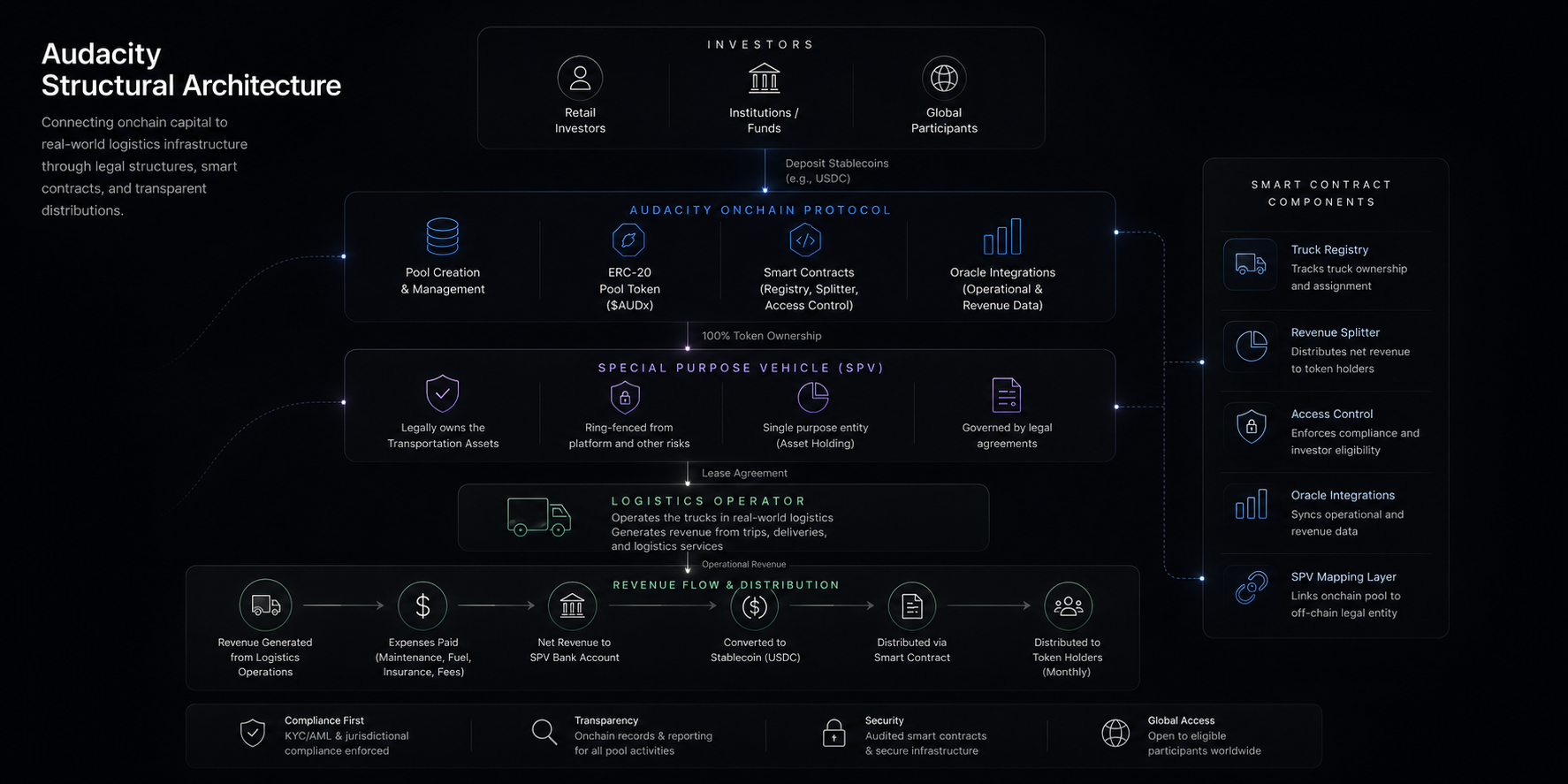
AudaCity is designed to connect these two layers:
- the operational transportation asset in the real world,
- and the programmable ownership and distribution infrastructure onchain.
The legal structure exists to ensure that token holders have clearly defined economic rights tied to real transportation assets and their generated cash flows.
The SPV Structure
Every transportation pool on AudaCity is structured through a dedicated Special Purpose Vehicle (SPV).
The SPV is a standalone legal entity established specifically to:
- hold transportation assets,
- enter operational agreements with logistics operators,
- receive revenue generated by those assets,
- and distribute economic proceeds to eligible token holders according to predefined rules.
Each SPV is isolated from both the AudaCity platform and other asset pools.
This structure creates clear separation between:
- platform operations,
- asset ownership,
- operator activities,
- and investor rights.
Key properties of the structure include:
Ring-Fenced Asset Ownership
Each SPV isolates asset-level exposure from platform-level exposure.
If AudaCity as a platform experiences operational or corporate difficulties, the underlying transportation assets and the SPV structures that hold them remain legally separate.
Investor exposure is tied to the SPV and its underlying assets, not directly to AudaCity’s corporate entity.
This separation is critical for protecting asset-level continuity and maintaining enforceable investor rights independent of platform operations.
Single-Purpose Structure
Each SPV exists solely to hold and administer specific transportation assets.
The SPV cannot:
- engage in unrelated business activities,
- use the assets as collateral outside defined agreements,
- borrow against assets without authorization,
- or materially alter the asset structure outside the framework defined in its governing documents.
This limits unnecessary structural risk and preserves alignment between investors and the underlying asset pool.
Defined Revenue Waterfall
Each SPV operates with a predefined revenue distribution framework.
Revenue generated from transportation operations flows through a transparent waterfall structure that prioritizes:
- operational expenses,
- maintenance and servicing obligations,
- insurance and compliance costs,
- platform management fees,
- and finally investor distributions.
The governing documents also define how proceeds from asset sales, refinancing events, or liquidations are allocated.
Jurisdiction and Compliance
SPVs are established within jurisdictions selected for:
- legal clarity,
- enforceability of contractual rights,
- operational compatibility,
- and compliance suitability for real-world asset operations.
The structure is designed to support compliant tokenized infrastructure participation while maintaining clear legal separation between assets, operators, and platform infrastructure.
What Token Holders Actually Own
AudaCity pool tokens represent legally defined economic rights connected to a transportation asset pool.
Token holders do not directly register ownership of individual vehicles in their personal names. Instead, the SPV legally owns the transportation assets while token holders receive proportional economic rights linked to the SPV.
These rights generally include:
- proportional participation in net operational income generated by the pool,
- and proportional participation in residual value or liquidation proceeds where applicable.
This structure allows investors to gain economic exposure to transportation infrastructure without the operational complexity of direct fleet ownership.
Direct ownership of commercial transportation assets across multiple jurisdictions would require:
- local registration processes,
- operational licensing,
- insurance obligations,
- tax administration,
- and extensive compliance coordination.
The SPV structure abstracts this operational complexity while preserving economic participation rights for token holders.
The token functions as the onchain representation of a legally structured economic interest connected to the SPV. Smart contracts automate the distribution of economic proceeds according to the SPV’s governing agreements and predefined distribution rules.
Origination and Asset Onboarding
Transportation assets can enter the AudaCity platform through multiple origination pathways.
Regardless of the onboarding source, the end structure remains consistent:
- a legally structured SPV,
- transportation assets deployed into operational logistics activity,
- and an onchain pool representing economic participation rights.
Channel 1: AudaCity-Originated Pools
AudaCity may directly coordinate the acquisition and structuring of transportation assets through its own origination pipeline.
Under this model:
- AudaCity identifies qualifying transportation opportunities,
- structures the SPV,
- coordinates asset acquisition,
- deploys vehicles into logistics operations,
- and launches the associated pool infrastructure.
This model allows AudaCity to standardize operational quality and accelerate deployment into high-demand transportation markets.
Channel 2: Logistics and Fleet Partners
Fleet operators and logistics companies can onboard existing or newly acquired transportation assets through AudaCity’s infrastructure.
Under this structure:
- the operator contributes operational expertise and fleet management,
- while AudaCity provides the tokenization, distribution, and investor coordination infrastructure.
This allows logistics operators to access alternative capital formation mechanisms beyond traditional bank financing or leasing structures.
Channel 3: Existing Asset Owners
Transportation asset owners may tokenize assets they already own and operate.
In this model:
- the owner transfers the assets into an SPV structure,
- receives the corresponding pool allocation,
- and may gradually introduce external liquidity participation over time.
This enables operators to unlock liquidity while continuing to operate the underlying assets.
Separation of Roles
AudaCity separates ownership, operations, and platform infrastructure into distinct layers.
This separation is important because it prevents conflicts between:
- asset management,
- operational control,
- and investor coordination.
| Role | Responsibility |
|---|---|
| SPV (Asset Holding Entity) | Holds legal ownership of transportation assets and serves as the contractual entity connected to logistics operations and investor economic rights. |
| Logistics Operator | Manages day-to-day transportation operations, including fleet deployment, logistics coordination, maintenance, and operational execution. |
| AudaCity Platform | Provides the tokenization infrastructure, smart contract systems, compliance coordination, investor onboarding, reporting systems, and distribution automation. |
This structure ensures that:
- operators focus on operations,
- SPVs hold assets,
- and AudaCity coordinates infrastructure and distributions.
If a logistics operator is replaced, the SPV and the associated token holder rights remain intact. The SPV can contract a new operator while preserving investor economic continuity.
Flow of Funds
The movement of revenue from transportation operations to investor distributions follows a structured lifecycle.
Step 1: Revenue Generation
Transportation assets generate income through:
- leasing agreements,
- haulage activity,
- logistics operations,
- enterprise transportation contracts,
- or fleet service agreements.
Logistics operators remit operational revenue to the SPV according to predefined agreements.
Step 2: Operational Reconciliation
Before distributions occur, operational obligations are deducted from gross revenue.
These may include:
- maintenance,
- servicing,
- insurance,
- operational management,
- compliance costs,
- and platform fees.
The remaining balance represents distributable net operational income.
Step 3: Stablecoin Settlement
Net operational proceeds are converted into stablecoins where necessary through regulated payment and settlement infrastructure.
This creates a standardized digital settlement layer for investor distributions.
Step 4: Onchain Distribution
Stablecoins are transferred into the distribution smart contract associated with the relevant transportation pool.
The distribution contract programmatically allocates proceeds proportionally across eligible token holders according to recorded ownership balances.
Step 5: Investor Receipt
Eligible token holders receive stablecoin distributions directly into their connected wallets.
Once proceeds reach the onchain distribution layer, distributions become:
- transparent,
- auditable,
- and programmatically verifiable.
Smart Contract Infrastructure
AudaCity uses smart contracts to automate the operational coordination layer of the platform.
Core infrastructure components include:
Pool Token Contracts
Manage ERC-20 participation tokens for transportation pools.
Revenue Distribution Contracts
Automate stablecoin-based yield allocation to token holders.
Asset Registry Contracts
Track transportation assets, pool assignments, and operational mappings.
Compliance and Access Control
Manage investor eligibility, KYC enforcement, and participation permissions.
Oracle Integrations
Sync operational and revenue data from logistics providers and fleet systems.
SPV Mapping Layer
Connect legal asset structures with corresponding onchain pools.
The protocol infrastructure is designed to make transportation asset coordination more transparent, auditable, and operationally efficient.
Regulatory Approach
AudaCity is building within a compliance-oriented framework for real-world asset infrastructure.
The platform incorporates:
- KYC and AML procedures,
- investor eligibility controls,
- legal SPV structures,
- and jurisdiction-specific compliance considerations where applicable.
As the platform expands, AudaCity intends to continue developing its regulatory and compliance infrastructure in alignment with evolving real-world asset frameworks globally.
Dispute Resolution
SPV governing documents and platform agreements define dispute resolution procedures between relevant parties.
Where necessary, disputes may be resolved through arbitration frameworks specified within the governing legal agreements.
The objective of the structure is to create:
- clarity of obligations,
- enforceability of investor rights,
- operational continuity,
- and predictable governance processes across the platform infrastructure.